Friday, February 18, 2011

Long Meseta Days End Up Being Best of Cyber Pilgrimage So Far

View Cyber Pilgrimage in a larger map

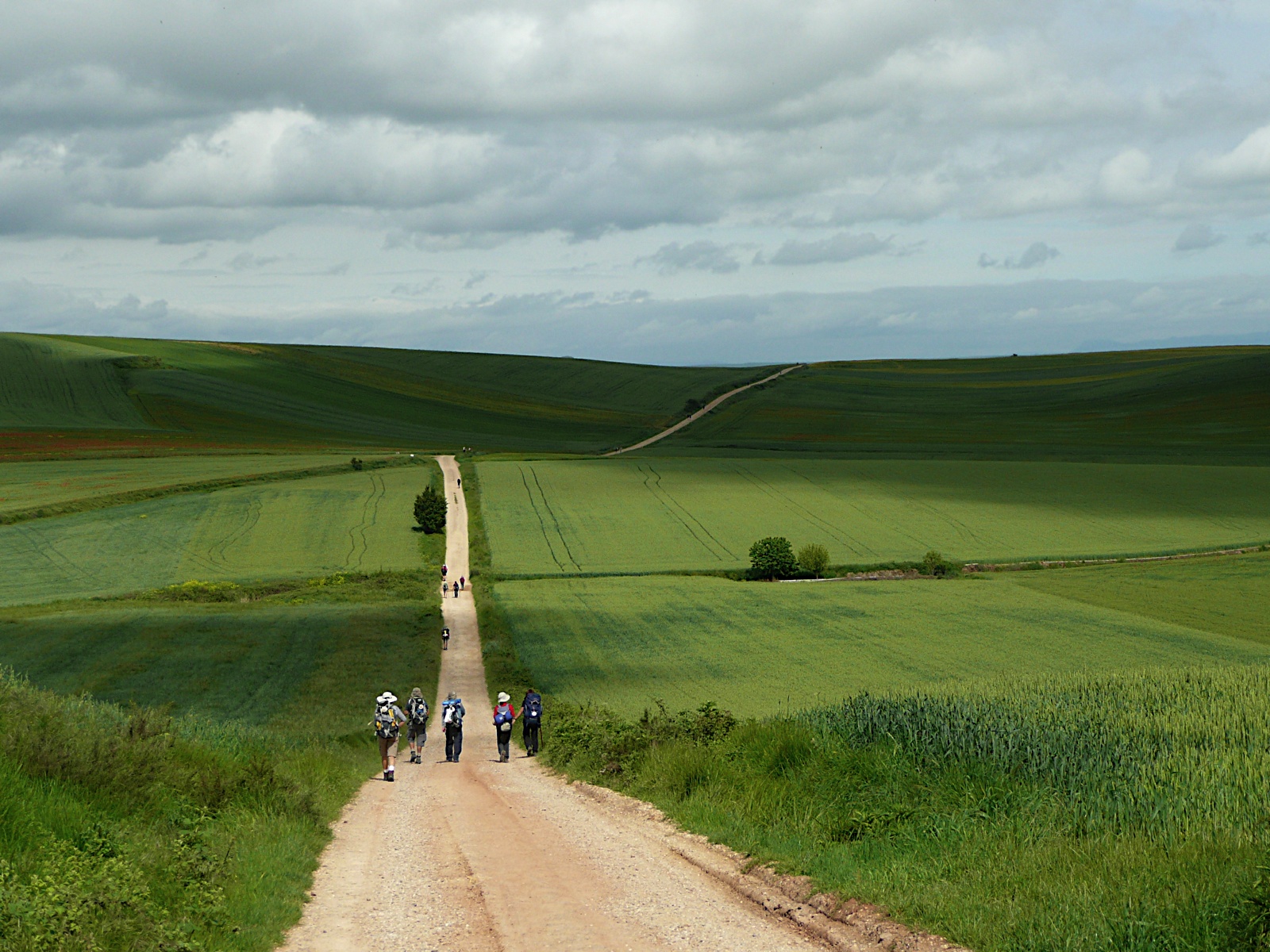
Few would guess that the Meseta would end up being our favorite stretch of the Camino so far. The vast swaths of flat countryside gave us easy (though long) walking and opportunities to walk side-by-side on the wider-than-usual gravel paths.

Though the gravel paths are blessedly wide, we've come to see the physical challenge of walking on gravel all day. The bottoms of our feet, though accustomed to long walks, become tender by afternoon and every oddly shaped piece of gravel can be felt even through the thick soles of our boots. Larger chunks of gravel turn the ankles just a bit, eventually making them ache. As we walk we begin to pay close attention to where we plant our individual steps, avoiding larger rocks or uneven ground to skip the annoying and constant tenderness that are part of every day's walk. Our big choices in the day are whether to walk in the ruts at the left or right side of the road or to walk in the middle which sometimes offers more even footing. Mundane thoughts like these are what occupy pilgrims' minds through the day.

At one point our plus-50 walkers held a song competition with the under-50 walkers based on who could think up song lyrics faster. When one group sang one line of a song the other group had to the count of "5" to come up with a pop song of their own that included one word from the previous song. Our competition lasted nearly all morning before the plus-50's won with the '70's song, "Muskrat Love" of Captain and Tennille. "Love" had been used long ago, but no could figure out anything that related to "Muskrat," so that did it. That meant that the plus-50's were each treated to a San Miguel by the younger crowd. One of the few benefits of being older. Cheers.


Ruins of Convento San Anton and the Camino
which passes through. 
After our evening in Hontanas we walked in admiration and amazement through the ruins of the Convento de San Anton, who buttresses straddled our narrow road. Afterward our now bronzed and thickly-muscled cyber pilgrim legs carried us easily to Fromista via the delightful town of Castrojeriz. This moon-shaped village is wrapped around a castle-topped hill which is a landmark for many miles. After Castrojeriz is the one large hill of the Meseta, an easily-climbed rise that once would've given us pause but now pales in comparison to the Pyrenees after St. Jean or the Alto del Perdon after Pamplona. Before settling into the albergue at Fromista we marveled at the 11th century Iglesia de San Martin and its amazing tiny sculptures at the eaves outside and its intricate columnar capitals inside.

Carrion de los Condes was our next stop. Here we faced a tough decision about whether to stay at the albergue or spend the extra cyber-dollars and stay at the plush Real Monasterio de San Zoilo. Since this is a cyber pilgrimage and our cyber pilgrimage credit card bills need never be paid we decided to opt for grandeur and our group enjoyed the cloisters and crannies of this restored medieval monastery, once one of the larger monasteries in Spain.

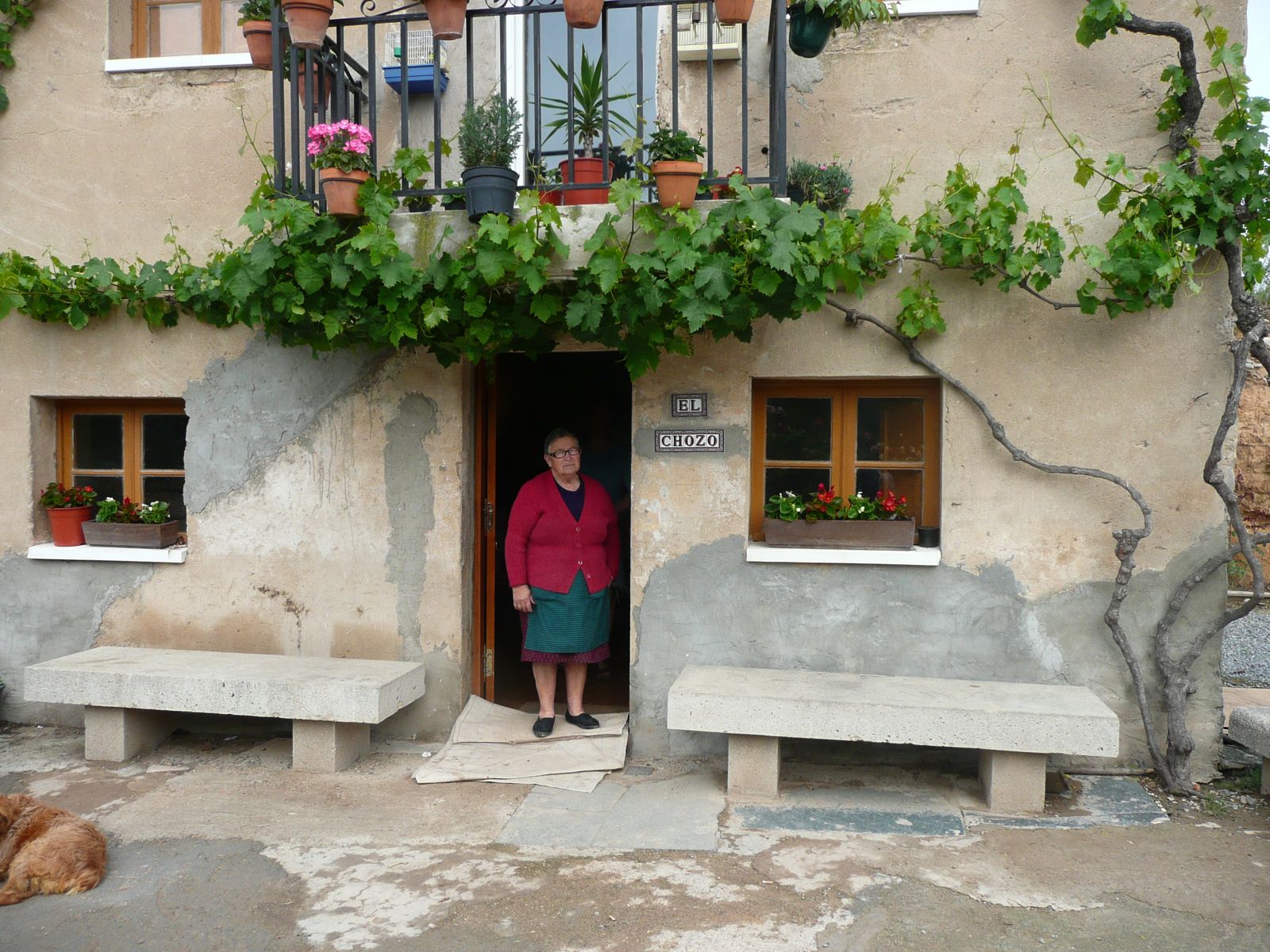
We next set our sights on Terradillos de los Templarios, a city whose name and history attach it to the Knights Templar of the Middle Ages. Now the town has only distant echoes of knights and swords. Instead it is a nearly deserted village, baked in the sun and quiet but for stray dogs and a few grandmothers on old chairs in shady doorsteps.


Tiny town of Templarillos, long removed from its
past with the Knights Templar.
After a comfortable stay in the family-owned albergue, complete with teenage kids and mom cooking our dinner, we headed through Sahagun (one of the Meseta's larger towns and the halfway point of our Camino) for an overnight at Bercianos del Camino Real.

Meseta days began to blend into each other as the names of towns grow confused in our minds, but after Bercianos our last night on the Meseta-proper was in Mansilla de las Mulas. Some say the Meseta actually ends in Astorga, but Mansilla is the last little town before Leon and it would be our final opportunity to enjoy the life of a tiny Meseta village on this Camino.

What is tiny village life like on the Meseta? I'm glad you asked. When we pilgrims arrive in a village at about 3:00 and settle into the albergue, we shower, wash our clothes, and then head "out" to see what the town offers. In a town like Mansilla there are two bars and not much else. So we walk along the street, passing adobe-style buildings on either side until we arrive at the bar. At this time of day the bar is filled with grizzled-looking elderly men playing either dominoes or cards and smoking cigarettes. As though of a single mind when we walk in all the men immediately stop what they're doing to gawk at the strangers (us). In an instant they realize we're just another bunch of pilgrims and they go back to their noisy games. After a beer or two (just one for our temperate pastor) we head back to the albergue to check on our laundry. Dinnertime is not until after 8:00 (sometimes much later in Spain) and as we walk to the bar (which is also a restaurant) we see grandmothers on chairs watching the pilgrim parade go by, waving at us shyly from their wooden door-front perches. We pass a dozen men who are bowling on the lawn. No one in this town is under 60 years old. All of them are having a grand time in community games and outdoor activities that are likely how they've spent the evening together since they were children. As we watch these economically-poor Spaniards enjoying life outdoors in this ancient town we realize how impoverished we rich Americans are. We have houses or apartments that would be the envy of any of these people, but they have a sense of community that does not exist in our TV-anesthetized culture. 


The bird-filled albergue at Mansilla de las Mulas
Our Mansilla albergue has a "bird problem," meaning that a couple of bird pairs are nesting inside the albergue among the pilgrims. As a result we can't close the windows since that'd separate the birds from their nests, so we leave the windows open through the night, duck down when we feel the rush of wings over our heads, and step carefully around the small bird exhaust piles that gather up between cleanings by the hospitaleros. 

Before bed that night we walk out to a dirt pile just below the ruins of a church where hundreds of birds have made their nests and we watch the sun go down over the next day's destination: the beautiful city of Leon, one of Spain's true treasures. The Meseta and its long, hot, flat walks is now behind us. Soon Leon will pamper us with its comforts and throw us out onto its steep mountain climbs, the last major mountains in our cyber pilgrimage.

Monday, February 14, 2011

After Fiesta Night Pilgrims Face Spiritual Challenge of the Meseta

Last night we American pilgrims showed pilgrims from Spain, France, Germany, Denmark, Brazil, Korea, Finland, and South Africa how to party American Methodist Style! Our international pilgrim friends were astounded that we could have so much fun while practicing the Virtue of Temperance. Still, it was a late night, so the 7:00 mandatory wake-up at the albergue caught us fast asleep in our bunks.
Burgos Cathedral, one of Spain's finest,
as seen from the upper cathedral square.

We sleepily walked to the lower cathedral square and slowly awoke over chocolate croissants and cafe con leche. By 9:00 the Cathedral Museum was open and we stood in line to get our credentiales stamped and learn more about one of Spain's most amazing cathedrals. 

Then it was time to tour the cathedral and the city itself. We set our sights on the two major monasteries, the medieval city walls, and the statues of heroes like El Cid. Too many sights and sounds to describe here, but suffice to say that we deserved a good rest at our second hotel (only one night is allowed per albergue), the El Cid which overlooks the cathedral. Tonight was about resting, not partying, and we washed our clothes, luxuriated in our rooms, and then sampled the cuisine of this fine city.

The next morning it was time to face the spiritual challenge of the Meseta, the second major stretch of the Camino Frances route. The Meseta is a vast, remote plateau, known among pilgrims for its long, desolate walks. Although the terrain is blessedly flat, there are few towns, with those being quite small and sometimes nearly deserted. Fortunately our Camino is not in the summer, because once the vast green fields are harvested the reddish brown earth radiates the sun back at pilgrims and the long days' marches are oven-hot and dry.
Our pilgrim fellowship begins to spread out as we
walk gravel pathways in the early stages of the Meseta

As we left Burgos the sky opened before us like on the American Great Plains. We could barely make out mountains far away toward the west -- the Montes de Leon -- which we'd climb in about a week. The terrain around us, though, was nearly as flat as Nebraska. An occasional river valley meant a small drop and then gain in elevation, but each hour brought more of the same -- boot on gravel, boot on gravel.

With nothing much to see we came to understand the spiritual challenge of the Meseta. We've now told each other most all our stories about ourselves. We now know each other's oddities and delights. Now we have just the terrain to entertain us, and our own thoughts. The terrain holds few mysteries -- like an open, blank book -- so our thoughts begin to absorb us. Our minds turn to grand and petty grievances, to big and small dreams, to hungers and hopes, to losses and failures. The distance stretches out between us pilgrims and we begin to walk almost alone. The solitude becomes a test of character. This is the Meseta.
The town of Hontanas, tucked into a river gorge.
We welcomed the tiny, mostly-deserted town of Hontanas, tucked into a river gorge and almost invisible until we had practically stumbled into it. The town has many ramshackle buildings, populated mostly by pigeons and stray cats. Its business is mostly pilgrim traffic and we settled into the rambling albergue feeling like we might be among the last generations to experience this fading ghost of a town. As we settled in, we realized the albergue included an unusual feature: a few double beds in private rooms! Our group took a vote and decided the double beds should go to couples in our group, so we singles said our good nights to them with a little smile and slept in the comfort of slightly smelly and somewhat noisy friends and strangers from all over the world. 

View Cyber Pilgrimage in a larger map


(This completes this week's mileage. Congrats for Team Charles which has now pulled out into the lead. Pilgrims please remember to get your new exercise totals to Greta so that we can conquer the spiritual challenge of the Meseta and enjoy the fleshpots of Leon)

Sunday, February 13, 2011

Pilgrims Stop in Burgos to Celebrate Pilgrim Grammy Night

It's Pilgrim Grammy Night in Burgos. We took our boots off and
put our party on in our first Big City stopover. See if you can identify
Lady Gaga, Eminem, Justin Bieber, and ????
Some may be wondering why we haven't seen many posts on the Cyber Pilgrim Blog lately (thank you, Jackie, for yours). First, let me assure you it is not because of sloth. In fact, when we came through Najera, our first night after Logroño, we stopped at the Monasterio de Santa Maria del Real there and heard a delightful sermon on "The Virtue of Diligence." Although he preached in Spanish, this priest clearly was eloquent and convincing about the case for keeping our pilgrim noses to the grindstone. I especially found his words about the average amount of time Spaniards watch television (which is actually much less than Americans due to the low quality of Spanish TV) to be inspirational. I immediately determined I would no longer watch "Millionaire Matchmaker" reruns from this point on -- I will wait only for the first-run episodes. I'm debating whether to cross "The Real Housewives of Beverly Hills" off my list, too, but am anxious not to appear extreme based on a inspirational sermon.


Crosses in the fence outside Logrono. Why are they
protecting the cars from us
No, it definitely was not because of sloth that we haven't posted. To be honest it was . . . .well . . . . lack of WiFi. We learned after we left Logroño's highways that we had momentarily left Western Civilization behind us. We made crosses out of sticks and wove them through the chain link fences that protected the roaring traffic from contact with pilgrims. The crosses, though, were almost like a "good bye," because once we left the side of the road we entered into miles of farmland -- vineyards -- that made us feel that we'd stepped back in time. We walked the gradual climb up to Navarette, then the long, steady climb to Najera. Here we found a small town of 7,000 that is closely connected to the pilgrims of this time and times past.

The Monasterio of Santa Maria del Real (where we heard the sermon) is a fabulous medieval edifice, built on the site where the son of King Sancho the Great followed his hunting falcon into a cave and there discovered a statue of the Virgin Mary. The cave is now part of the church, and as we walked through the building after the service we noted pilgrim motifs -- scallop shells and gourds -- carved into the centuries-old choir pews. We remembered that our walk follows the trail of millions over centuries who sought to find the spirit on the road to Santiago.


Monasterio de Santa Maria del Real -- not the first
sermon on the Virtue of Diligence we'd ever heard.
After Najera it was more walking on remote roads, with an entire day's walk punctuated by only one little town (Azofra) prior to our overnight at Santo Domingo de la Calzada. Your humble author was happy to see this little town, and only partly because he convinced us to bag the albergue bunks and instead to stay in one of his favorite Camino hotels, the Hotel Parador in Santo Domingo. In Sandy's first Camino he left his walk here in order to meet his wife, Gail, who was giving a talk in Copenhagen. He took a bus to Burgos, then a train to Bilbao, then a plane to Copenhagen so that he could surprise Gail at her hotel. Sure enough, she was shocked! As he arrived in Copenhagen he realized, though, that he had left his favorite hat at the Parador in Santo Domingo. When he returned after a couple of days of watching Gail give lectures in Copenhagen the hotel had nicely kept his hat wrapped in a plastic bag at the desk awaiting his return. Since then he's always had a soft spot for this place. Besides, it is right across the square from the church which has such an interesting story.

The church's story goes like this: About 1000 years ago a family was walking to Santiago and they stopped at Santo Domingo. A village girl immediately fell in love with the family's eldest son and, when he spurned her advances she ran to her parents and accused him of indecencies. His parents flew into a rage, had him arrested, and later that day the young man was hung (to death, presumably). His family continued on to Santiago (we all know about pilgrim timelines) and, upon their return, were surprised to see their son hanging from the rope -- alive! They ran to the bishop to ask him to cut down their son. The bishop, who was just about to dig into a dinner of two beautiful roasted chickens, said, "Your son is as dead as these chickens on my plate," at which point the birds jumped up and ran out the door. The bishop was startled and immediately had the son cut down from the gallows. Ever since that day two (live) chickens are always kept inside the church. It's said that if they cluck while you are in the building you will have a fabulous Camino. It's said if they don't cluck, you will still have a fabulous Camino.
Vast fields of green just outside Santo Domingo

I have done my duty and told you one of the Mandatory Camino Stories. As you can see, not all stories of the Camino are completely plausible, but they are always, well, weird.

Off we went the next day to Tosantos, a worthy distance goal of 28 kms. Here we came to understand the unbelievable beauty of the Spanish countryside. The vast distance of plains, with waving green fields of grain, was breathtaking. After a good, long day of walking with a brief stop at Grañon (a beloved pilgrim stopover because its albergue is housed in a church) we arrived at the tiny village of Tosantos to find a black-haired hospitalero who invited us to cook dinner with him after we'd finished our laundry. We cooked a dinner of beef stew, with various members of our group cutting meat or vegetables, and after a time our hospitalero friend had whipped it up into a sumptuous feast. Before we could eat, though, he asked if we would follow a member of the local church up to the grotto above the town where the statue of the Virgin Mary was kept. We headed up the hill on the other side of town and sat in the cold cave as we were told, in Spanish, about the miracles caused by the Virgin through the statue.

We returned to the albergue and dined on beef stew over pilgrim chatter to a boom box CD of Taize music. After dinner we were invited to the uppermost room at the albergue and there we read aloud the written prayers of pilgrims who had stopped here three weeks prior. As our hospitalero explained, these people had now made it to Santiago and by saying their prayers we would be praying with them. We were surprised at the stories included in the prayers -- stories of sins committed or sins suffered, stories of addictions or endings -- and after our prayers we wrote down our own prayers with the same openness and vulnerability, knowing that pilgrims who followed us three weeks hence would read our prayers and make them their own.


Our next night's hideout after the plush digs of the
Santo Domingo Parador Hotel
The next morning we left Tosantos behind, headed to the nearby town of Villafranca del Montes de Oca, which is the gateway to another mountain pass. Here your humble author reminded our group of what one pilgrim encountered along this road about 800 years ago. As he walked the lonely path through the woods he happened upon a pack of wolves tearing away at the flesh of a dead pilgrim. With one voice the entire group told your humble author to keep his mouth shut now for the rest of the day, but whenever there was a rustle in the woods our groups eyes all quickly darted in the direction of the sounds.

As we came down from Montes de Oca free of wolf bites we arrived at the town of Atapuerca, a tiny village with two bars, three albergues and one world-famous museum. After the busloads of schoolchildren left in the afternoon we stopped by the museum to discover that Atapuerca, a UNESCO World Heritage Site, is the place where some of the most ancient hominid bones in Europe were unearthed by anthropologists. Delightfully, the museum's video about these early human-like beings was all in English (produced by the BBC, no less). We stood in awe as we watched and realized that these valleys and mountains were home to "people" for thousands of years before us.

After a night at the albergue in Atapuerca it was time to make our assault on Burgos. There's little to say about walking through the industrial suburbs of one of the Camino's major cities. This town, birthplace of Francisco Franco and the city where Ferdinand and Isabella sent Columbus on one of his voyages, is one of two large metropolises we'll visit on the Camino. What does that mean? Pilgrim fiesta!

Given the Grammy Awards happening this very night back in the US of A we decided to hold a Grammy-themed event at a local karaoke bar just off the cathedral square. Everyone unpacked their gowns and tuxedos from their packs and spiffed up for a night of singing and reminiscing about American Pop Culture. Yes, the city of Burgos has one of Spain's finest Gothic cathedrals. Yes, it was the home of El Cid. Yes, we were surrounded by culture. But tonight, it's pilgrim fiesta night and we're taking off our hiking boots and putting our party on!

Pilgrimage Euchre, Anyone?

Jackie's fantastic Euchre hand, on miniature cards.

(Jackie Speaking): Some may have wondered what has happened to our little band of pilgrims since we haven't been heard from in a few days. After we lost our two pilgrims in the torrential downpour in Viana Wednesday evening (don't worry, as mentioned in the earlier post, they were airlifted to safety and then decided to go home) and after a short walk to Logrono, we decided to take it easy and just hang out with each other in this fabulous city. After all, our lesson on diligence was not scheduled until next week. (For our lesson this week on Charity, Susan led us in providing some of our pilgrimage currency to pilgrims we met along our way so that they too could visit the home of Feliza.) The walk through La Rioja was fantastic, there's nothing quite like the smell of vineyards in the open air, and we experienced this for much of our walk.

That next day still in Logrono, we decided to visit Con-Catedral de Santa Maria de la Redonda in addition to Iglesia de Santiago that we had visited the previous day. This Cathedral was built over a former 12th century Romanesque temple. Many additions and restorations have been made to this Cathedral over the centuries. The significant twin towers on the exterior were not added until the 18th century while the side doors were added at the beginning of the 18th Century, the Gospel side dedicated to San Martin. A vault in the church houses a Michelangelo painting of the Crucifixion of Christ, forgotten for many years and not found again until later in the 20th Century.

We then decided to stop by Calle Portales near the Plaza del Mercado where we ate previously and at the foot of the Con-Catedral de Santa Maria de la Redonda, to examine this main street of the old town of Logrono. From there, we headed over to Calle Mayor, a popular weeknight hangout, for some good food and drink. As we were sipping our world-class Rioja wine, I pulled out my miniature deck of playing cards so that we can hold a good old fashioned Midwest Euchre tournament. The cards were miniature of course, since I had to limit the weight of my pilgrimage backpack. Our evening of fun went well into the night and as Alison and I battled Bart and Rockstar for the top Euchre win spot (I won't state who won because we wouldn't want to brag), I heard that Dana tried, successfully I might add, to shoot the moon in Hearts. We heard much laughter from Jeanne, Elissa, Gwynne, and Dawn during their bridge game and the tensions were high amongst Lisa, Greta, Erin Elaine, John and Susan as they were nearing the 18th hole of their game of golf (the card game of course). Don't worry, we'll get back on our feet with all those blisters soon and head off to the next city. Team John, especially, has some catching up to do.

Thursday, February 10, 2011

Search and Rescue Helicopter Lifts Lost Pilgrims to Safety

Catherine, thankful for a rescue from the swollen
Rio Valdearas, decides to end her pilgrimage
on a high note.
By the time we realized Catherine and Connie were gone it was late into the evening. We sent a delegation to the Viana police to report them missing, but had little hope they'd turn up that night. As we heard other pilgrims describe the cloudburst we realized the downpour had been bigger than we'd thought. Apparently several pilgrims had been swept away in the rivers of rain and hail that filled the streets of Viana.

The next morning we packed up to head toward Logroño and, at the banks of the Rio Valdearas we watched as Connie, then Catherine were airlifted from an island in the swollen river. They both appeared happy, serene even. We shouted and waved to get their attention, but the noise of the helicopter was too loud and soon they were whisked off, over the horizon, to a local hospital.

We learned later that the fast waters coming off the hill in Viana had caught them, forcing them downhill and ultimately into the river. They'd spent the night on the island along with three French pilgrims who knew little English, but they shared French PowerBars for sustenance and, when they were spotted in the morning, a British pilgrim named Covey called for Search and Rescue. Later that night we had an e-mail from Connie, apologizing for a change of plans for the two, who had decided at the hospital that the walking, blisters, bunk beds, and occasional helicopter rescue didn't fit their idea of a vacation. Bye, Connie! Bye-bye, Catherine!
Lovely Logroño, capital of Spanish wine country
and our overnight after the heroic rescue.

We remaining pilgrims decided to walk a short day, with plans to challenge ourselves only with the 8 kms to Logroño, one of the great pilgrim towns of the Camino. As we crossed the Rio Valdearas we entered the autonomous region of La Rioja, Spain's internationally-famous wine country. We'd seen vineyards for many miles, but we realized now we had entered the heart of it all. We walked past the ruins of prehistoric city of Cantabria, then walked on asphalt path and back alleys to a beloved pilgrim rest stop -- the home of Feliza. For many years Feliza's aunt, also called Feliza, has welcomed pilgrims into her home and offered the hospitality of toast, jam, cafe, and fruit for an offering of a few coins each. We shared in her hospitality, had our credentiales stamped, then headed across the new bridge into the vibrant city of Logroño.


The original Feliza, shown here in 2008. Thanks, Cariña,
for your care of 1000s of pilgrims over the years.
This city of 130,000 is like a classy, Spanish version of Bellingham, Washington. The university brings a youthful vibe, the historic architecture brings a medieval feeling, and the Iglesia de Santiago marks it as a portion of Camino history. We noticed the statue of Santiago Matamoros (St. James the Moor-slayer) at Iglesia Santiago, reminding us of the story of Santiago's heroic and miraculous rout of the Moors in a nearby battle some 1,000 years after his death. 

We caught dinner at the Plaza Mercado and then retired for the night at the municipal albergue -- after prayers of thanksgiving for the rescue of our friends, of course.


Tuesday, February 8, 2011

A Great Camino Video Thanks to Huffington Post

My thanks to George Derk and Huffington Post for sharing this great Camino Video. Enjoy!


Torrential Hailstorm Strands Pilgrims in Viana Overnight

Just a few kilometers out of Torres del Rio we came to a lookout that allowed a vista over the coming two towns: Viana and Logroño. As we looked over these mid-sized cities of Navarre and La Rioja we saw on the western horizon a vast strip of black storm clouds. At this point it wasn't clear they were heading toward us, but their presence gave us a sense of foreboding -- with no place in the vineyards and low bushes between here and Viana we would be vulnerable to whatever Mother Nature might throw at us.


With grim determination we walked briskly toward Rio Cornova, barely noticing the ancient ruins there. Just over an hour later we arrived in Viana, with the sky turning dark and the wind picking up. Here we faced a choice: press ahead to Logroño to cover additional ground during daylight, wait here until the storm passed, or stay overnight here in Viana to take advantage of the warm and dry albergue, staying off wet and muddy pathways. After a brief discussion the answer was clear: wait it out and see if the weather allowed more walking after the storm passed overhead.


Interior of Iglesia de Santa Maria, our refuge from
the hailstorm outside.
We staked out a rendezvous at the the 13th century Iglesia de Santa Maria and sent Connie and Catherine to find a good cafe/bar to hang out at and Alison and Jackie to the main albergue to see if it was a place we'd want to stay. The rest of us ventured into the gorgeous church. 


The splendor of the church is a clear indication of the prominence of the city in the Middle Ages. The gilded altar, the beautiful stone work, and the height of the ceiling are all indications of the care and expense that went into its construction. The church is also burial place to the infamous Italian, Cesare Borgia -- churchman, politician, military strategist and scoundrel who was praised as being an example of what Machiavelli meant in The Prince.


As we gazed at the church's statue of Santiago, one of the oldest on the Camino, we heard a loud crash coming from outside, followed by the sounds of a torrential rain storm pounding on the roof of the church. We headed to the door to witness the violent downpour and stood in amazement at the almost twelve inches of water that had already begun washing down the stone pavers of the medieval street. Soon the rain was replaced by hail and just as we were about to close the doors of the church we saw Alison and Jackie splashing down the street toward us, their hands over their heads for protection from the pelting of the hail.


Entrance to the Viana Albergue -- the morning after the
big storm when we discovered the fate of two of our group.
After the two arrived we waited another ten minutes, hoping for the storm to let up. At Jackie and Alison's urging we decided to head to the main albergue, just a block or so from the church it turned out, in order to assure ourselves beds for the night. We gathered up our packs and covered them with their waterproof covers, then headed out into the deluge for the albergue.


Although we were only about 50 steps away we were drenched by the time we reached the foyer of the albergue. We signed in, had our credentiales stamped, found our beds (triple-decker bunk beds in this crowded albergue) and got into dry clothes. By this time the storm had mellowed into a heavy rain and we all agreed it was time for a good dinner, so we headed to a nice restaurant just across the street and had a beautiful menu del peregrino. As dessert arrived, I think it was Elissa who asked the question, "Where are Connie and Catherine?"


We sat there in stunned silence. The last we'd seen them was before the storm.


This week's mileage totals are: Team John: 65.9; Team Charles: 95.7. Congrats to Team Charles for taking the lead. We regret that Connie and Catherine have dropped out of our cyber pilgrimage. Visit the blog tomorrow to find out what calamity has happened to them.